
Late last year, I was already brainstorming ways that we could highlight Black History Month at the library. I knew that we would not be resuming in-person programs by February, so I was contemplating passive methods for a fun and intellectually stimulating activity.
I have two coworkers who are quite enthusiastic about the television gameshow Jeopardy! Overhearing one of their conversations provided my creative spark. I decided to create a self-directed, Black History Month-themed Jeopardy! gameboard on one of our large accent walls.
My work began by deciding on the categories and then developing the prompts. True to an actual Jeopardy! game, I opted for five categories: Arts & Entertainment, History & Politics, Literature, Science & Innovation, and Sports. Each category featured five prompts, for a total of 25. Naturally, I also created a Final Jeopardy! category (Architecture & Design) and prompt.

Category titles were printed on standard, 8.5 x 11 paper. Prompts were printed on legal size paper. Each prompt was designed as two pages, with the second page inverted. This allowed me to print the prompts double-sided, and then fold them in half in order to hide the answers beneath the prompts.


I also created a printable scorecard. Our Teen Librarian was marketing her Black History-themed books display as “Black Histories and Futures Month.” She prefers that language and I had no objections to following her lead on the wording.

Finally, to complete this stage of my prep work, I organized a PDF for our website and events calendar with all of the prompts and answers, which also included recommendations for books, films, and music.
Once all of my pages were designed and printed, I moved on to getting the parts ready for the gameboard. My Cricut-saavy coworker in our Circulation department assisted me with designing and cutting out lettering and borders.
By mid-January, I had everything I needed organized into folders and ready to assemble.
I got to work on assembly the morning of February 1st. After some debate and calculations, I decided to assemble the gameboard before I attempted to adhere it to the wall. I’m glad I went that route, because I was able to ensure that all of the pieces were evenly spaced and the dimensions uniform while everything was laying flat, rather than trying to get those measurements while standing on a step ladder.
I began by cutting out a long piece of white kraft paper. I rolled out the paper on a large open floorspace and began applying all of the titles and prompts using copious amounts of double-sided tape. Once I was confident that everything was securely taped to the front of the gameboard, I had a coworker help me flip the whole thing over to the back side. Then I went wild with applying rolled-up painter’s tape every few inches across the back. I wanted as much security as possible once it was taped to the wall.
The gameboard now complete, a coworker assisted me with adhering it to the wall. It was pretty secure just with the painter’s tape on the back, but I also added a layer of painter’s tape around the borders just to be extra cautious.
Finally, I applied my border pieces to the gameboard and all of my lettering and set out the scorecards with a few pens–and that was a wrap!
All in all, the assembly stage of the project took me between 4-5 hours.

The wall is a similar shade of blue to the Jeopardy! gameboard pieces. As such, I wanted to make sure to bring in some other colors to liven up the presentation, which I did with cascading tiles of bright construction paper.
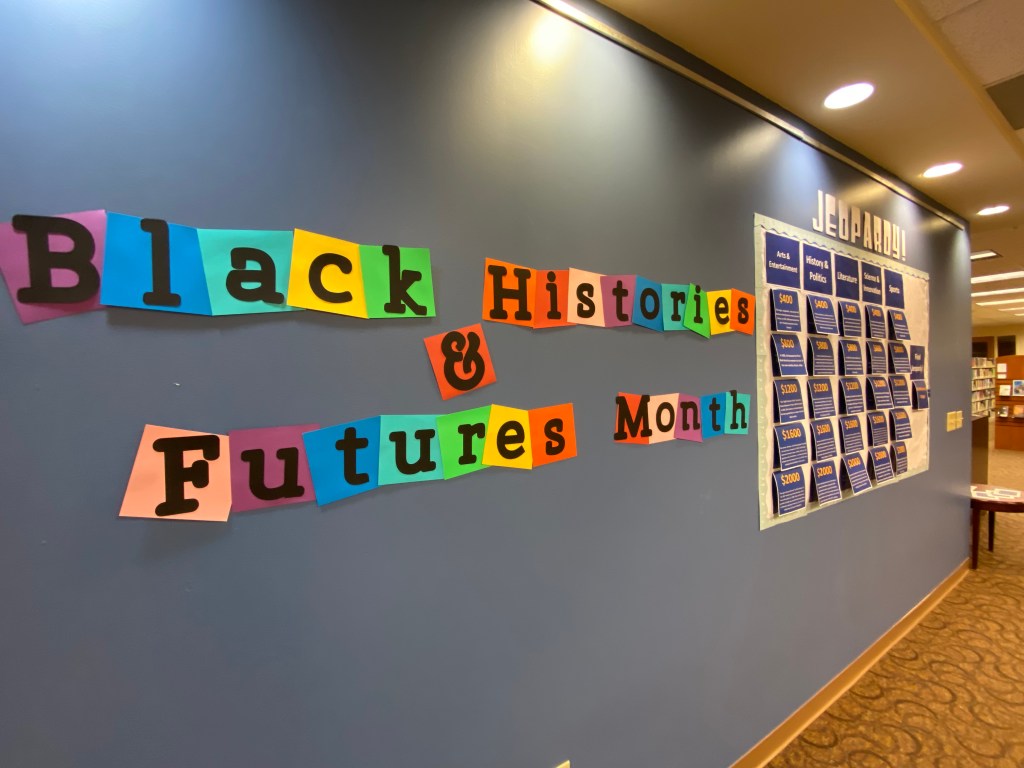
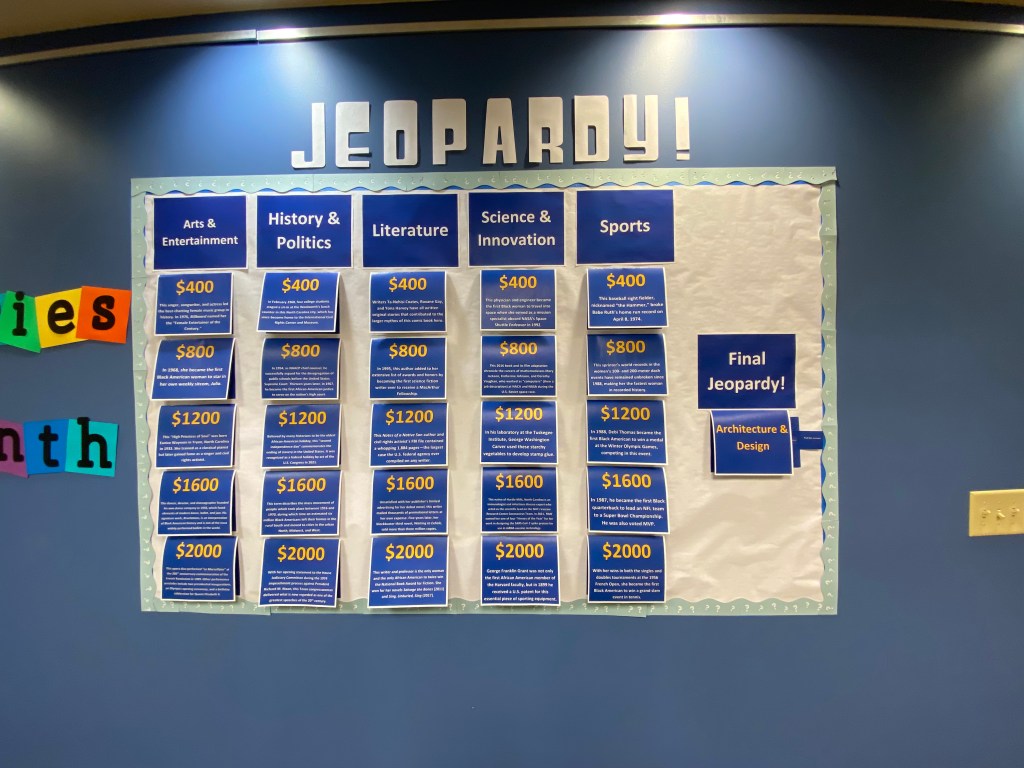
You can see in the above picture what I consider to be my biggest strategic mistake when I was executing the design. The tape around the edges of the gameboard is visible behind some of the border pieces. This could have been avoided if I’d bought standard-sized painter’s tape instead of wide. I’m anal enough that the hint of blue tape peeking through behind the border had my eyes twitching every time I noticed it.

Result: The patrons who played the game seemed to really enjoy it. In all, we went through about 20 scorecards, although I saw many people interacting with the game who weren’t keeping track of their scores. Some of the feedback said the prompts were a bit too difficult (oops), but people also appreciated learning new facts.
 Public Library World