
We’ve been flirting with the idea of hosting a cookbook club for a couple of years now. So when we began discussions around resuming in-person programming post-Covid, this seemed like an obvious choice. Cookbooks are one of our most popular collections, and we live in an area with a bourgeoning foodie movement and restaurant scene.
I did some research on how other libraries have done cookbook clubs. Some clubs organize their meetings around broad themes (e.g. vegetarian, Italian, etc.), and participants are free to choose any recipe they like. Other clubs focus on one book at a time and everyone makes one recipe from the book. After some consideration, we decided that we prefer the latter format. As a library event, we liked emphasizing a particular book over a more freestyle cooking club.
Our next step was to solicit interest. This was our first in-person event post-Covid, and the foot traffic in the library had been pretty slow since reopening. So we were a little worried about how many people we could get to turn out. We put together a promo widget for social media that instructed people to contact us to express interest. We also put up a few fliers around the library. We got about 12 response emails, which gave us enough confidence to move forward with the event.

I teamed up with a coworker and we got to work on creating a list of essentials. First we needed to consider the necessary supplies. We purchased compostable plates, saucers, bowls, cups, napkins, and cutlery. To keep foods at temperature, we also purchased three warming trays and three ice mats. With food safety in mind, my coworker contacted the county’s Health Department to request any information they had to share. Our contact at the Health Department provided a handout about safe cooking temperatures that we now attach to every welcome email we send to registrants.
Our final preparatory step was to pick a book. I gave my coworker first choice, and she picked The Complete Mediterranean Cookbook by America’s Test Kitchen. We ordered two extra copies of the book so that we had three total. We held one back for library-use only, and changed the circulation period on the other two from three weeks to one week. We also added a digital copy of the book to OverDrive/Libby.

We knew that we would need a way to keep track of the menu for the event and to make sure that we weren’t duplicating recipes. I put together a Google spreadsheet which could be shared with every event registrant. This requires some extra effort and attention. We manage event registrations via the library’s calendar software. As a second step, I check the sign-up page every day and directly email new registrants a welcome message, which includes the safe food temperatures document mentioned above as well as a link to the shared spreadsheet.

We had 15 registrants for our first meeting, of which 13 signed up for a recipe on the shared spreadsheet. On the day of the meeting, I debated with seating arrangements before deciding on a square shape that would allow the entire group to interact with one another.
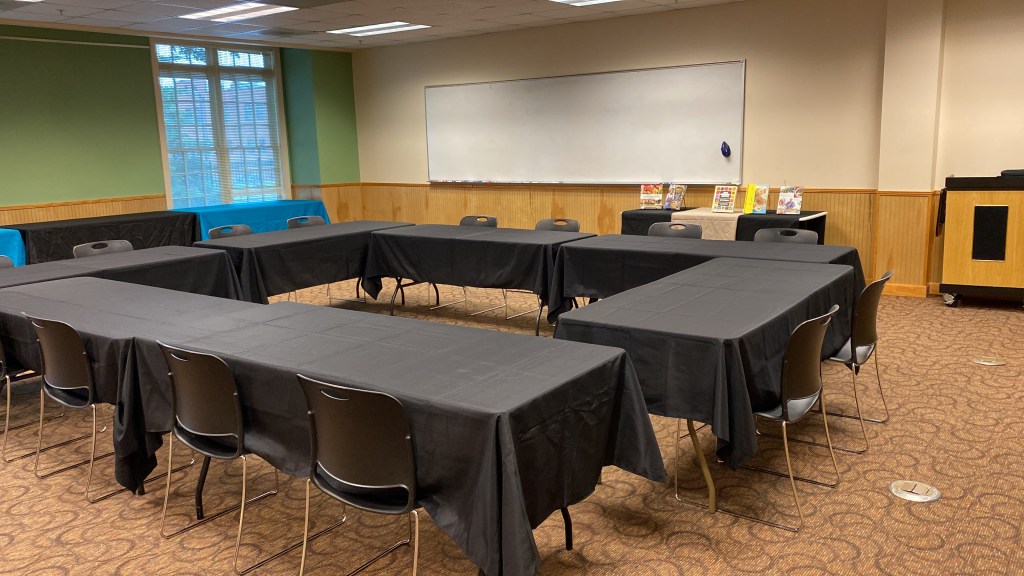
You’ll notice a table with books below the white board. Even though we had four copies of our first book, interest was high enough that they circulated slowly, even with the special circ period of one week. We decided that, moving forward, we would only choose books that were available in hoopla, one of our digital resources that has hundreds of thousands of items that are always available. I scanned the hoopla catalog and made a record of as many books as I could find that were also in the library’s physical collection. In advance of the first meeting in July, I went ahead and selected the August book (Marcus Off Duty by Marcus Samuelsson), then I randomly selected three more titles that the group could vote on for the September meeting. Working two months in advance like this gives my coworker and I time to prepare by ordering an extra copy for library-use only and having our Technical Services team change the circ period on the library’s copy to one week. We’re a small library and don’t have room for two copies of the same book, so at the end of every meeting, we hold a raffle drawing to give away the extra copy.
Things were so hectic during the first meeting that we didn’t snap many pictures. But you can see photos below from our second meeting, highlighting the Marcus Samuelsson title.

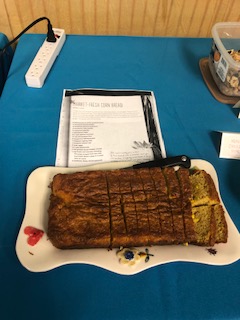
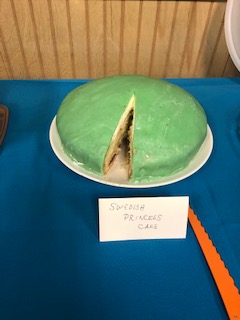


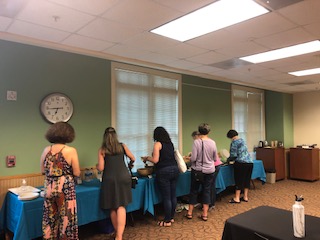
Result: This program has been very popular! At the first event in July, we had 12 participants (one no-show). In August, we had 13 participants (again with one no-show). As I write this, we’re about a month out from our September meeting and have 16 registrants. These might not seem like very large numbers, but after the first meeting we decided to cap the event at 20 people. That provides more than enough food and gives us just enough time to go around the table and each share a little bit about our recipe and our impressions of the book.
Feedback from the participants has been overwhelmingly positive. We’re developing a regular set of club members whose ages range from 20s to retirees. In particular, we’ve heard that these events are filling a community need for fun, recreational events for adults (that don’t involve children!).
These events require a lot of effort and staff time! Set up takes longer than you would imagine, and clean up takes even longer. For planning purposes, I would recommend factoring in at least an hour before and after the meeting for prep and striking.
 Public Library World