
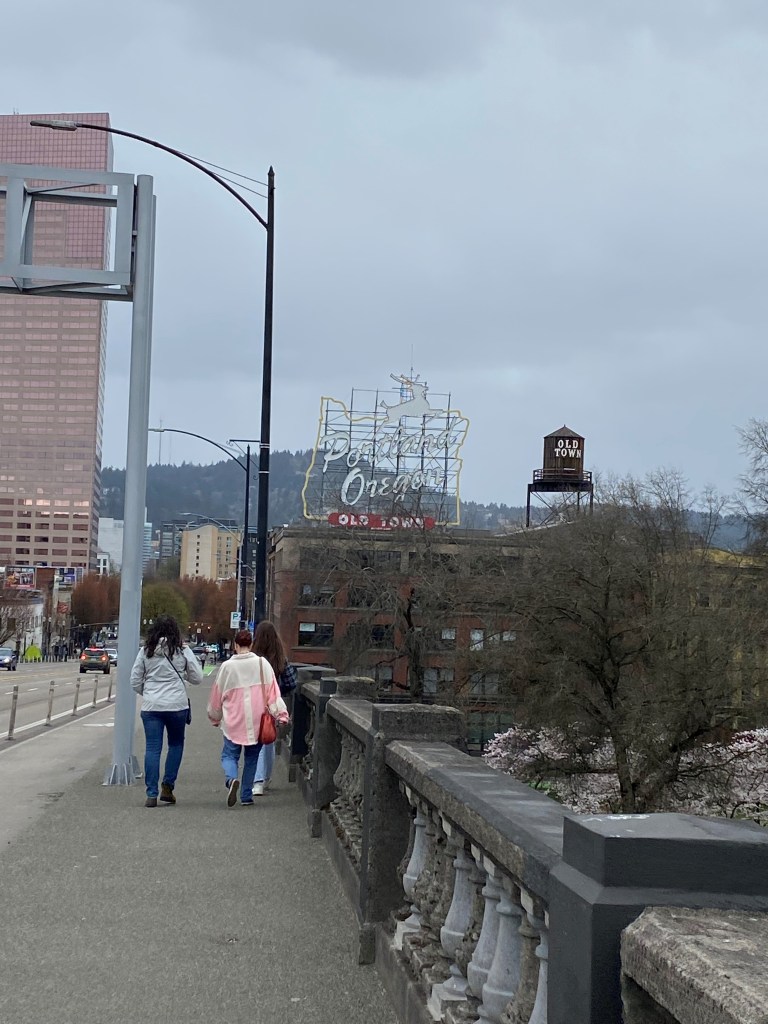
This March, I was lucky enough to attend the Public Library Association’s (PLA) biennial conference in Portland. This was my first major in-person conference since PLA 2018 in Philadelphia.
At my first few sessions, I was delighted to see a big crowd again. It wasn’t until my coworker and I visited the exhibits hall that we recognized just how sparsely attended this conference was. It was night and day from my experience in Philadelphia, where I felt a bit overwhelmed at times by the compression of so many people inside the convention center. It wasn’t helped by the fact that I was simultaneously dealing with some awful, bronchitis-like illness at that time. Oh, and a mini-blizzard hit the city the very morning we arrived, so even more people than usual were congregating indoors. So, on the whole, even with some pandemic precautions still in place, this was an improved experience over my last PLA.
As this was the first PLA since the chaotic events of summer 2020, much of the program content felt like catch-up, largely dedicated to topics concerning DEI initiatives and strategies. Below are some reflections from a handful of the sessions I attended.
Clear and Kind: Building Boundaries in Outreach Work
Presenters: Kate Morgan (King County Library System) and Rachel Beckman (Sno-Isle Libraries)
A well presented session on the importance of establishing boundaries from the outset when engaging in outreach work. There were several ideas from this session that stood out to me. First, the presenters referenced a couple of helpful terms:
Resilience Narrative: The idea that librarians often experience burnout and difficulty in establishing boundaries due to a belief that librarianship is a resilient profession and that good staff always go above and beyond. (Via Kaetrena Davis Kendrick)
Vocational Awe: Here’s a definition from the coiner of this term, Fobazi Ettarh: “Vocational awe describes the set of ideas, values, and assumptions librarians have about themselves and the profession that result in notions that libraries as institutions are inherently good and sacred, and therefore beyond critique.”
In truth, I’m not entirely sympathetic to Ettarh’s theory. She makes it halfway to a necessary truth but then falls into a paradox with her own burnout narrative. I agree wholeheartedly that the proclivity of librarians to feel awe in their profession and to conceive of themselves as superheroes is, largely speaking, detrimental. But it is detrimental precisely because it leads to a lack of perspective and to too many overwrought assertions (I call it the “I’m Basically a Social Worker” Fallacy).
Quibbling over terminology aside, I did pick up some concrete ideas from this session. To name a few:
(1) Consider contacting your HR department before beginning any new, major outreach projects.
(2) Outreach work is ideally performed with a service agreement in place. Consider having the agreement re-signed by the relevant parties every year.
(3) With any kind of home delivery service, STOP AT THE DOOR! Do not enter the patron’s house. Make this point clear in the service agreement from the outset.
(4) Invest time into developing documentation for appropriate processes and procedures.
(5) Encourage an environment conducive to internal knowledge sharing among staff.
Programming for Neurodiverse Adults and Others: Ten Best Practices
Presenter: Carrie Banks (Brooklyn Public Library)
The 10 best practices were as follows:
- Invite neurodiverse adults to the table (consider creating an advisory board).
- Build relationships with ALL stakeholders.
- Partner with advocacy groups and community organizations (e.g. the Autistic Self-Advocacy Network and The Arc).
- Involve the entire library and work to overcome institutional ableism (consider the social model of disability and Applied Behavior Analysis).
- Take multiple identities and cultures into account.
- Offer sensory tools and spaces, visual supports, and communication options.
- Make existing programs inclusive and train presenters and volunteers.
- Apply Universal Design (UD) and Universal Design for Learning (UDL).
- Use chronological age to guide content; use developmental age to determine style and materials. (Carrie gave a good example of this practice, making reference to a sex education class for neurodiverse adults her library co-sponsored with Planned Parenthood.)
- Network to share resources, program ideas, and support.
Creating a Dynamic and Diverse Authors Series
Presenters: William Kelly and Wendy Bartlett (Cuyahoga County Public Library)
Excellent presentation from these two presenters. A few highlights:
- Think of an author series in the same terms as merchandising.
- Pay attention to ALL authors and genres. In particular, try to identify debut authors and books with potential for later popular success.
- From the publisher’s standpoint, it’s all about your marketing reach. They don’t care how many books you sell at the event. They want the publicity.
- An author series should not require a large budget or a huge investment of time. Bill estimated they spend between 3-4 hours a week on author events.
- Utilize the event grids in Edelweiss. In particular, make use of the “Make Request” function to propose an author event to the publicist (and, on this point, learn how to write a strong proposal). Also pay attention to the initial print run.
- Check out Shelf Awareness for ideas.
- Collection HQ has a helpful DEI module to track the diversity of your collection and, ergo, your events.
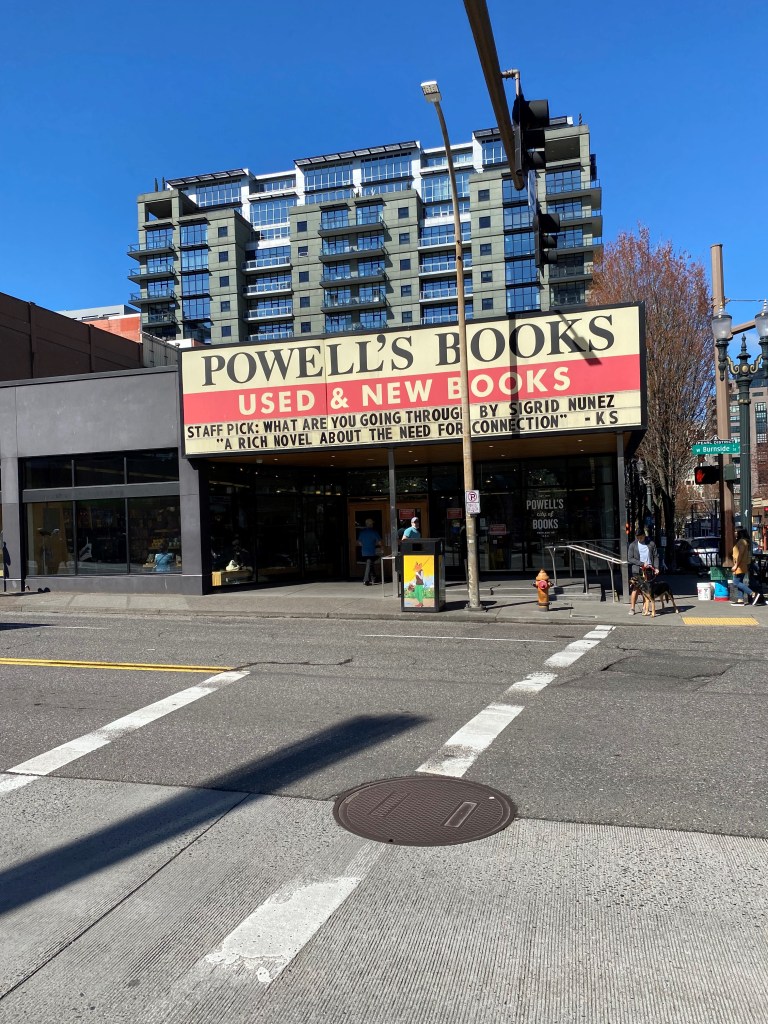
Finally, I would be remiss not to mention that I made not one, not two, but three trips to the historic Powell’s Books, which was a five-minute walk from our hotel. It lives up to its legacy as the largest independent book store in the world. I even got lost a couple of times during my first visit. It was hectic and crowded (no doubt with plenty of my fellow PLA attendees), but a delightful experience for any book lover. Don’t miss the opportunity to visit.
I’ve been home for a week now with no sign of COVID (*knock on wood*). I wore a mask when required (airport, airplane, rideshare, and during the conference), but otherwise I opted to bare my naked face to the good people of Portland. I was boosted six days before I traveled, so maybe that provided the extra layer of defense I needed? Either way, this was my most extensive travel in two years and I’m thankful to have avoided a second round of COVID.

